Custom Magnetic Closure Boxes: The B2B Sourcing and Engineering Guide for Premium Brands
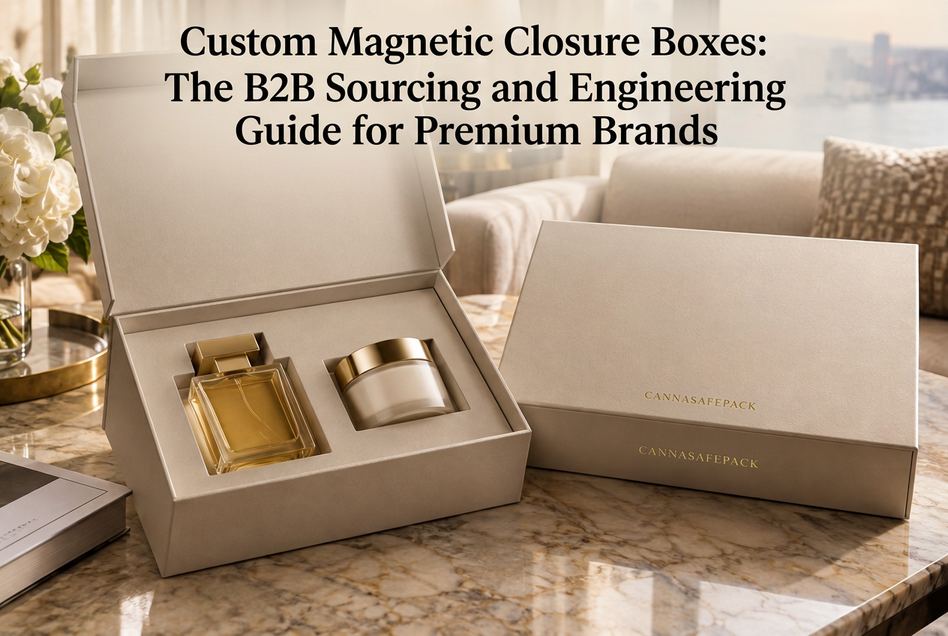
For luxury consumer brands, electronics innovators, and beauty manufacturers, packaging is not merely a shipping container—it is the first tactile handshake with the customer. Among all premium rigid packaging structures, custom magnetic closure boxes have emerged as the definitive benchmark for prestige presentation, combining structural permanence with an addictive, sensory snap upon closing.
- 1. Structural Architectures: Collapsible vs. Rigid Pre-Assembled Builds
- 2. Core Greyboard Densities, Wrapping Papers, and Luxury Surface Finishes
- 3. Precision Custom Inserts and Hardware Calibration for Seamless Unboxing
- 4. B2B Sourcing Strategy: Dielines, Quality Testing, MOQ, and Production Lead Times
When scaling procurement from initial prototypes to full container-load wholesale production, brand owners and packaging procurement managers often encounter substantial trade-offs between freight footprint, structural rigidity, magnet polarity calibration, and surface finishing precision. This technical sourcing guide details the engineering principles and manufacturing parameters required to specify custom magnetic closure boxes without costly trial-and-error.
1. Structural Architectures: Collapsible vs. Rigid Pre-Assembled Builds
The primary architectural decision in magnetic closure box engineering lies in choosing between a collapsible flat-pack format and a factory-assembled rigid box. Both variants utilize high-density greyboard and concealed neodymium magnets, yet their supply chain economics and unboxing ergonomics differ markedly.

Collapsible magnetic boxes rely on precision V-groove cuts engineered into the rigid greyboard core. These micro-grooves enable the box body to fold perfectly flat during transit and pop up into a sturdy 90-degree walled box at the fulfillment station using high-adhesion peel-and-stick corner tabs or hidden corner magnets.
Ideal for: E-commerce brands, international air freight, high-volume retail rollouts with constrained warehousing.
- Freight Reduction: Reduces international shipping cube volume by up to 70% compared to rigid setups.
- Storage Efficiency: Minimizes cubic pallet space in distribution hubs and fulfillment centers.
- Assembly Requirement: Requires 5 to 10 seconds of manual setup per unit before packing.
Ideal for: High-ticket luxury retail, fine jewelry, limited-edition spirits, and turnkey gift sets.
- Maximum Rigidity: Zero seam deflection; solid, monolithic corners wrapped seamlessly without adhesive tabs.
- Zero Prep Time: Ships ready-to-fill, drastically lowering fulfillment station packing time.
- Logistical Trade-off: Higher dimensional freight weight and elevated warehouse space consumption.
2. Core Greyboard Densities, Wrapping Papers, and Luxury Surface Finishes
The tactile heft of a magnetic closure box is directly dictated by the caliper (thickness) and grammage of its internal greyboard skeleton. Professional B2B buyers avoid generic "thick cardboard" terminology and instead provide exact density specifications based on product weight and box surface area.

Standard industrial greyboard ranges from 1000 gsm (approx. 1.5mm caliper) for compact cosmetic cases up to 1800 gsm (approx. 2.8mm to 3.0mm caliper) for substantial apparel, heavy bottles, or high-end electronics. Specifying insufficient caliper leads to lid warping over time, which compromises the alignment of the hidden magnets.
| Greyboard Spec | Caliper Thickness | Typical Application | Recommended Paper Wrap |
|---|---|---|---|
| 1000 – 1200 gsm | 1.5mm – 1.8mm | Jewelry, watches, luxury cosmetic compacts | 128gsm – 157gsm coated art paper or specialty buckram |
| 1400 – 1600 gsm | 2.0mm – 2.4mm | Consumer tech devices, skincare sets, apparel boxes | 157gsm C2S art paper with soft-touch matte lamination |
| 1800 – 2000 gsm | 2.8mm – 3.2mm | Spirits, luxury hampers, heavy machinery instruments | Heavy embossed leatherette, soft-touch tactile paper, or bookcloth |
To finish the exterior, wrapped face papers are combined with advanced post-press techniques. Soft-touch anti-scratch matte films prevent fingerprint smudging on dark-colored boxes, while precision hot-foil stamping and multi-level blind debossing create subtle, tactile luxury branding without compromising surface durability.
3. Precision Custom Inserts and Hardware Calibration for Seamless Unboxing
The signature unboxing feature of any magnetic box is its audible, satisfying closure snap. Behind this seamless interaction lies precise mechanical calibration. Industrial box makers embed high-grade sintered neodymium magnets (N35 or N42 grade) into precision-milled pockets within the greyboard core, perfectly flush with the board surface before the face paper is laminated.

Depending on the closure force required, engineers use either two opposing magnets (positive and negative poles precisely aligned) or a single magnet paired with a thin galvanized steel strike plate. For wide front flaps exceeding 200mm in width, dual or triple magnet placements prevent the corners from flaring outwards.
Custom Insert Substrates
A luxury exterior requires an equally protective interior. The product must sit firmly in place during drop impacts while lifting out smoothly without binding:
High-Performance Insert Options
- High-Density EVA Foam: CNC-routed or laser-cut to exact CAD product geometries. Offers exceptional shock absorption, clean edges without fraying, and can be laminated with velvet, microfiber, or custom-printed cardstock.
- Eco-Friendly Molded Pulp Trays: Engineered from 100% recyclable sugarcane bagasse or FSC kraft fibers, contoured precisely to cradle bottles and glass containers for sustainable luxury programs.
- Thermoformed Plastic Trays (Flocked Vac-Trays): Lightweight, precision-formed trays coated with electrostatic velvet flocking for intricate multi-component kits.
- Integrated Ribbon Pulls: Grossgrain or satin pull-tabs embedded beneath the insert base to allow customers to effortlessly extract products or reveal hidden lower compartments.
4. B2B Sourcing Strategy: Dielines, Quality Testing, MOQ, and Production Lead Times
Procuring custom magnetic boxes from overseas manufacturers requires clear quality assurance benchmarks to avoid communication bottlenecks and production delays. Professional procurement protocols focus on four critical checkpoints:

1. Structural Dieline Verification: Always request unprinted structural white samples (dummy samples) cut on CNC sampling tables before approving digital artwork. Test how your physical product fits inside the insert and check that the magnetic flap snaps shut naturally without requiring manual guidance.
2. Drop and Environmental Testing: Verify transit durability via ISTA 1A or 2A drop testing protocols. Test whether magnets stay anchored in their pockets under extreme temperature fluctuations (-10°C to 50°C), ensuring specialized hot-melt adhesives do not delaminate during ocean transit through humid equatorial shipping lanes.
3. Commercial Order Quantities (MOQ): Due to custom die-tooling setup and automated box-wrapping machine calibrations, standard production runs typically start at 1,000 to 2,000 units. Sampling costs are usually credited against the mass production purchase order once approved.
4. Lead Times and Logistics: Structural sample turnaround averages 5 to 7 business days. Full mass production typically spans 18 to 25 business days, followed by ocean container transit (20 to 35 days depending on destination port) or expedited air freight for urgent retail launches.
Custom Perfume Packaging Boxes: The B2B Structural Design and Sourcing Guide
Custom Collapsible Rigid Boxes: The Definitive B2B Sourcing Guide for Luxury Brands
Related Article